

Educational games do not always need a screen, a board, cards or complicated rules.
Sometimes, a simple sheet of paper and a set of colored pencils can provide an excellent starting point for a creative learning activity.
Coloring is often considered a quiet pastime for young children, but it can also be used to encourage observation, storytelling, creativity and conversation. The activity becomes even more engaging when children are not coloring a completely unfamiliar illustration, but an image connected to their own lives.
A family photograph, a picture of a pet, a holiday memory or a familiar place can all become the starting point for a personalized coloring activity.
This creates an interesting bridge between play, creativity and learning.
Why coloring can be more than a simple pastime
Coloring naturally involves making choices.
Which colors should be used? What part of the picture should be colored first? Should the child follow reality or invent something completely different?
These small decisions give children an opportunity to experiment and express themselves.
Coloring can also be incorporated into broader educational activities. Educational games and hands-on activities can help children engage with concepts in a more active way, while creative activities such as drawing and arts and crafts provide opportunities for imagination and self-expression.
The important point is not to turn every coloring session into a lesson.
The activity can remain fun while naturally creating opportunities for learning.
Turning familiar photos into coloring activities
One way to make coloring more meaningful is to start with something the child already knows.
Instead of giving them a generic picture of a dog, for example, why not let them color a drawing based on their own dog?
The same idea can work with family photographs.
A picture from a birthday party, a family holiday, a day at the beach or a visit to the grandparents can be transformed into a coloring page.
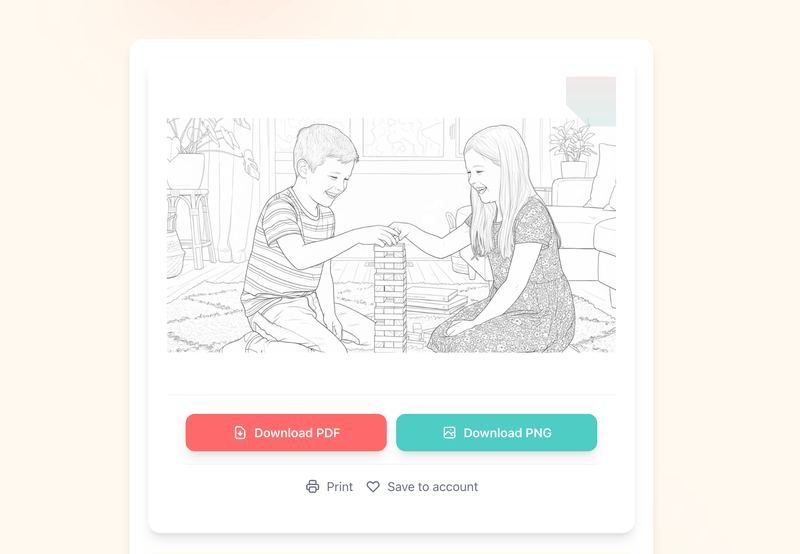
Services such as Coloriboo for personalized coloring pages allow families to turn their own photographs into printable coloring activities.
The photograph provides the structure of the illustration, while the child decides how the final version should look.
This makes the activity immediately more personal.
The child may recognize the people, objects and places in the image, which gives parents or teachers an opportunity to start a conversation around the picture.
Using coloring to develop observation skills
A personalized coloring page can also encourage children to look closely at an image.
What can they see?
Who is standing in the picture? What objects are around them? What is happening in the background? Can they remember where the photograph was taken?
These questions can turn a coloring page into a simple observation game.
For younger children, adults can ask straightforward questions:
- How many people can you see?
- What animals are in the picture?
- What is the person holding?
- What can you see in the background?
- Which object should we color first?
Older children can be encouraged to notice smaller details or describe what they think happened before and after the photograph was taken.
The coloring page therefore becomes the starting point for an activity rather than the entire activity itself.
Turn a coloring page into a storytelling game
Another simple idea is to use personalized coloring as the beginning of a story.
Imagine a child is given a coloring page based on a photograph from a family vacation.
Before coloring, ask them to describe the scene.
Where are the characters? What are they doing? What happened that day?
Then introduce an imaginative question:
What if something completely unexpected happened next?
Perhaps the family discovered a treasure. Perhaps the dog ran away with a picnic basket. Perhaps the children found a secret door behind a tree.
There is no need for the story to remain connected to the original photograph.
The image simply provides the starting point.
This type of activity can combine visual observation with vocabulary, imagination and storytelling while keeping the child in control of the creative process.
Connect coloring with vocabulary
Personalized coloring can also be adapted to language activities.
For example, a teacher or parent could choose a photograph showing several familiar objects and ask the child to identify them before starting.
A kitchen scene could introduce words such as table, chair, plate, window and cupboard.
A photograph from the beach could lead to words such as sand, shell, sea, towel and umbrella.
A picture of a family pet could introduce vocabulary related to animals, body parts or movement.
The activity can be adapted to the child’s age and current level.
Younger children can focus on naming objects and colors.
Older children can describe the scene using complete sentences or write a few sentences about the photograph after finishing the coloring page.
Create a themed educational coloring book
Instead of using individual coloring pages, families and teachers can also create a small themed collection.
The theme could be based on a subject the child is already learning.
For example:
A nature coloring book
Collect photographs of trees, flowers, insects, animals and outdoor environments.
Children can color the images and then identify the different elements they see.
A family history coloring book
Use photographs of parents, grandparents and other family members.
This can become an opportunity to talk about family relationships, places where relatives have lived and important family memories.
A travel coloring book
Choose photographs from a holiday and organize them chronologically.
Children can color each page and then describe the journey from beginning to end.
An animal coloring book
Create a collection of photographs featuring pets or animals encountered during a trip.
Children can color them and learn the names of the animals, their habitats or basic facts about them.
The possibilities are almost unlimited because the content starts with photographs that are meaningful to the child.
A creative alternative to screen-based activities
Many parents are looking for ways to diversify the activities children do during their free time.
Educational games can be useful tools, but not every activity needs to happen on a tablet or computer. The Educational Games for Kids website itself highlights the importance of balancing screen use with physical and creative activities such as drawing, reading and crafts.
Personalized coloring fits naturally into this approach.
The photograph may initially come from a smartphone, but once the coloring page has been printed, the activity becomes completely physical.
All that is needed is paper and something to draw with.
It can be done at home, in a classroom, during a holiday or as part of a quiet afternoon activity.
Let children decide how the picture should look
One of the most important parts of a creative activity is allowing children to make their own decisions.
A personalized coloring page should not become an exercise where there is only one correct answer.
If the sky is blue in the original photograph, the child does not have to use blue.
The grass does not have to be green.
A dog does not have to have the same colors as the real dog.
Children can reinterpret the image however they want.
This is particularly interesting from an educational perspective because the activity combines a recognizable visual reference with freedom of expression.
The photograph provides the framework.
The child creates the final version.
Turn the finished drawing into another activity
The learning does not have to stop when the coloring is finished.
The completed page can become the starting point for another small project.
A child could write a few sentences about the scene, create a title for the picture, invent a story about the characters or explain why they chose particular colors.
Several finished pages could also be assembled into a homemade book.
For example:
“Our Summer Adventure”
Page one could show the journey.
Page two could show the beach.
Page three could show a family meal.
Page four could show a visit to a particular place.
The child can then add captions, drawings or short descriptions to each page.
A simple coloring activity has now become a small creative project involving writing, storytelling and visual expression.
Coloring can also work as a collaborative activity
Coloring does not necessarily have to be an individual activity.
Parents and children can work on the same project together.
Teachers can also organize collaborative activities around a collection of personalized images.
One child might color the main characters while another works on the background. Afterwards, they can explain their choices to each other.
This creates an opportunity to practice communication and cooperation while keeping the activity informal.
It also means that the finished result becomes something the children have created together rather than simply an exercise they had to complete.
The educational value is in the activity, not just the worksheet
A coloring page on its own does not automatically become an educational game.
The interesting part is what happens around it.
A familiar photograph can lead to questions.
Questions can lead to conversations.
Conversations can lead to stories.
Stories can lead to writing or drawing.
And the finished illustration can become part of another creative project.
This is why personalized coloring can be particularly useful for parents and educators looking for flexible activities.
There is no single way to use it.
The same coloring page can be used for a quiet creative session with a five-year-old, a storytelling exercise with an older child or a classroom project built around a particular subject.
A simple way to combine learning and creativity
Educational activities do not always need to be complicated.
Sometimes, starting with something familiar is enough.
Take a photograph the child recognizes, turn it into a coloring page and let them decide what happens next.
Ask questions.
Invent a story.
Learn new words.
Talk about a memory.
Write a short description.
Or simply color the picture together.
The result is still a coloring activity, but it can become much more than that.
By connecting familiar experiences with creativity, personalized coloring offers a simple way to bring learning, imagination and hands-on play together — without requiring another game, another app or another screen.